I entered with a single prompt. I came out with a product.
How a twelve-panel comic about Tyrol's energy future became the start of Memolio.

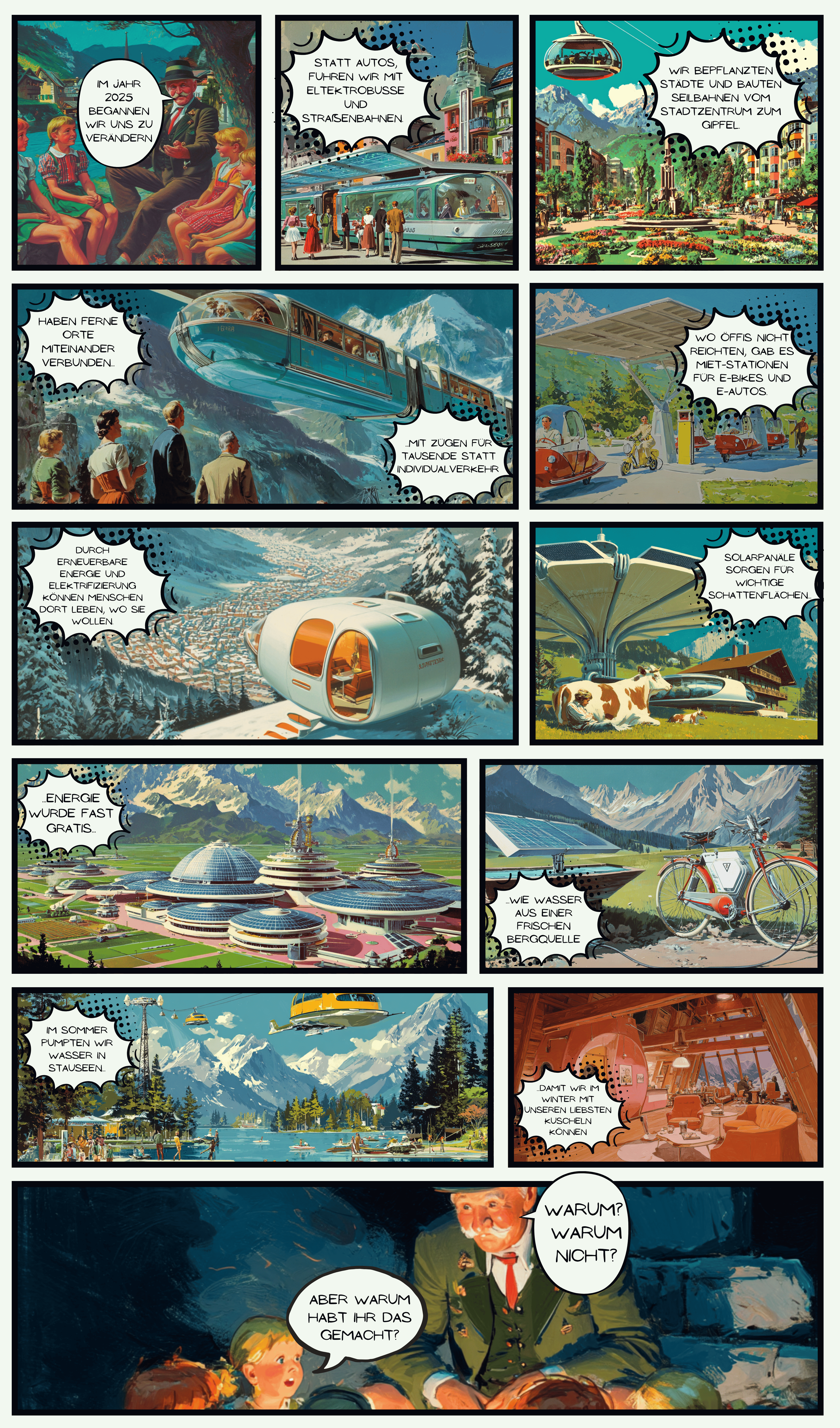
A few months ago I entered the Tirol 2050 comic competition. The brief was simple: show your vision of Tirol’s energy future. I sat down with one idea and the intention of getting it out in a single image.
I ended up with a twelve-panel comic, and not long after I was building Memolio.
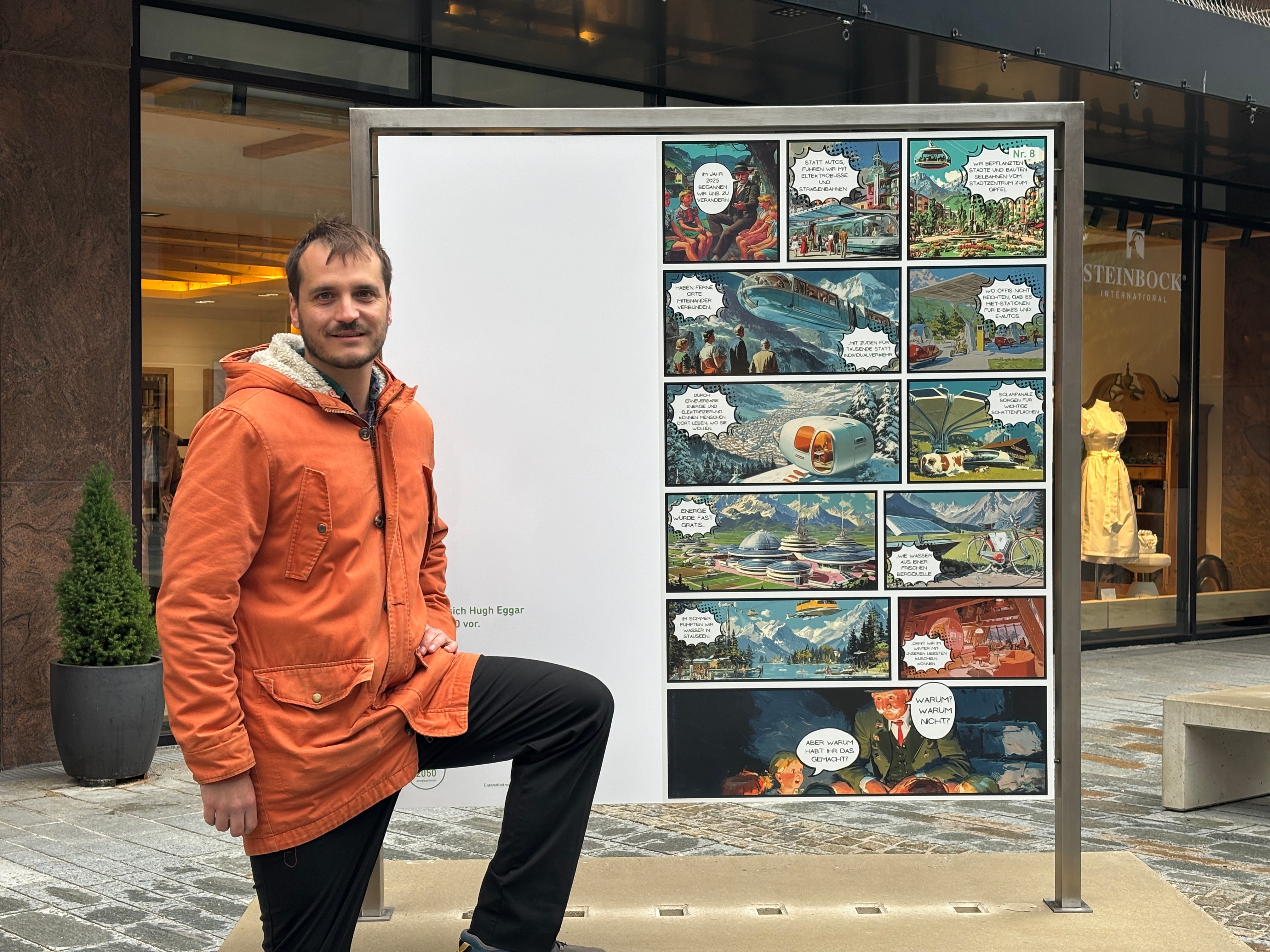
This week I found out it won a prize. Thank you to Tirol 2050 for picking it, and to Gloryfy for the indestructible sunglasses that came with the win. As a deeply messy and unorganised person, I am intent on testing them to their limits!
I want to talk about what happened between sitting down with a single image in mind and ending up with a sequence, because I think it’s a pattern worth naming.
The original prompt was already loaded. An old man in traditional Austrian ‘Tracht’. Children at his feet. A 1950s retrofuturist palette. Solar panels glinting off alpine farmhouses. I fed it all in and got back a perfectly competent image. It was fine. It was also flat.
What was missing wasn’t quality. The model can render Tracht and solar panels just fine. What was missing was meaning. The image didn’t say anything. It didn’t have a beginning or an end. There was no question being asked and no answer being given. It was a tableau.
So I added a second panel. Then a third. Then I kept going. By the time I stopped I had twelve. Electric trams and buses threading green city streets. Cable cars climbing from town centres to mountain peaks. Mountain villages alive again because energy is nearly free. Cows resting in the shade of solar canopies. Near-free electricity moving like water from a mountain spring. Summer water pumped up to reservoirs so families could keep warm with the people they loved in winter. Eleven panels of patient build. Then the twelfth: a small child looking up at the old man and asking, “But why did you do it?” And the old man answering, “Why? Why not?”
That last exchange is the entire point of the comic. There is no single image in the world that contains it. The question only lands because eleven panels have already painted the world the question is being asked about. The answer only lands because you’ve already started caring about the old man. You need the build, the pause, and then the punch.
That was where I had a quiet realisation that has shaped the last six months of my life.
Single prompts are a one-frame medium. They can be beautiful, evocative, sometimes startling. But they are structurally unable to carry an arc. The model does not know what came before and does not know what comes after. The viewer has to do all the editorial work in their head, and most viewers won’t.
Narrative is the unlock. A handful of pictures and a handful of words in sequence can do what no single generation can. They can hold a question over a beat, then answer it. They can age a face across pages. They can let a grandfather be a child first, before he is anyone’s grandfather.
After the competition I started sketching what would become Memolio: a workflow that turns a grandparent’s life into an illustrated book. The product is built on the same insight as that twelve-panel comic. It isn’t really in the business of generating beautiful single images, although it does that as a side effect. It’s in the business of stringing them together into a story that means something to one specific family.
The Tirol 2050 brief was about renewable energy. The lesson I took away was different and, for the thing I’m building, more useful. AI gets interesting the moment you stop asking it for an image and start asking it for a story. The output is no longer something you look at. It’s something you read.
That shift, from looking to reading, is the entire game.